Artistic Heritage of Kyiv-Pechersk Lavra
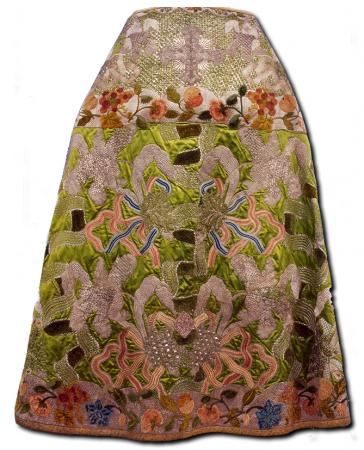
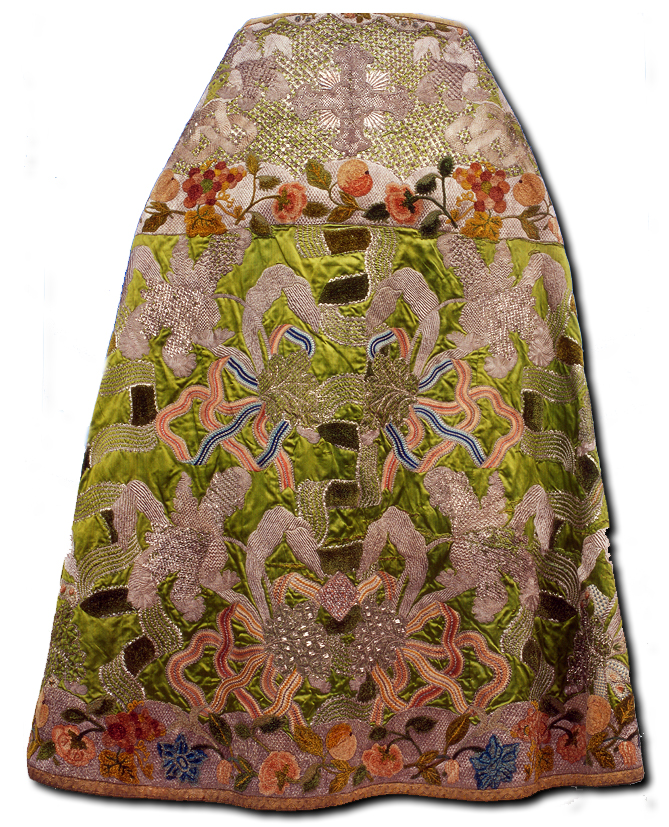
Embroidered phelonion of the 1760s from the Collection of the Preserve
Dear friends!
Today, we present to your attention an embroidered phelonion of the 1760s - the donation of Piora (Glebova), the nun of the Kyiv-Florovsky Ascension Convent, to the Dormition Cathedral of the Kyiv-Pechersk Lavra (KPL-T-229, 130,0×180,0 cm).
The donor of the phelonion - Paraskeva Glebova (1704‒1782) was the wife of Ivan Glebov, the Governor-General of Kyiv (1762–1766). The couple had five sons and three daughters. After her husband had been appointed as a senator and moved to St. Petersburg (1766), Paraskeva remained in Kyiv. The Glebovs kept in touch and corresponded constantly.
At her own free will, the general’s Glebov wife took the vows with the name Piora at the Kyiv-Florivsky Convent. During her life, she made generous donations to Kyiv's monasteries and temples. At the beginning of the 19th century only in one Dormition Cathedral of the Kyiv-Pechersk Lavra there were 22 fabric items made at the expense of the donator. Unfortunately, most of them have not been preserved.
The green satin phelonion, decorated with hand embroidery, was donated to the Lavra complete with epitrachelion and deacon sticharion, executed in the same manner. These objects were firstly described in the property inventory of the Dormition Cathedral in 1767. To this day, only the phelonion and a stycharion’s fragment (KPL-T-1256) have survived.
On the green satin background of the phelonion there is a large pattern formed by intricately intertwined knot of ribbons and flowers. The pattern is made of silver threads and blue, dark blue and green chenille (silk hairy thread). The bottom of the shoulder and the hem of the vestment are outlined by wide silver borders with a wavy edge. The shoots with rose flowers, cornflowers, apples and bunches of grapes are skillfully embroidered in the middle. Floral motifs were made with multicolored chenille with intricate chiaroscuro design to obtain the effect of plasticity.
The ornamental composition of the phelonion imitates French textile ornamentation. In the 18th century, almost all liturgical vestments in Ukraine were sewn from French silk fabrics, often interwoven with gold and silver. They were appreciated for the splendor of the decor and rich colors. Due to the high cost of French fabrics, imitation of their texture by hand embroidery has become widespread. Despite the amount of work, such objects were still cheaper due to low labor costs.
The text was prepared by Alina Varyvoda, PH. D. In History,
senior research worker, Research Division for the Study of Artistic Heritage
Captions to illustrations:
Fig. 1. Phelonion. The 1760s. Donation to the sacristy of the Dormition Cathedral of the Kyiv-Pechersk Lavra, made by Piora (Glebova), the nun of the Florovsky Convent.
/socialmedia/icons/levelten/glossy/32x32/youtube.png)
/socialmedia/icons/levelten/glossy/32x32/facebook.png)
/socialmedia/icons/levelten/glossy/32x32/twitter.png)