National Kyiv-Pechersk Historical and Cultural Preserve has joined the challenge #MuseumFromHome
 Dear Friends!
We congratulate you sincerely on the feast of the Holy Trinity! We wish you peace, goodness, love, health, happiness, and all the best!
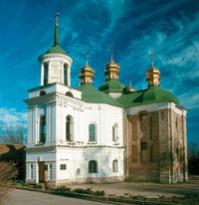
On this occasion, we present to your attention unique artifacts from the interior of the Trinity Gate Church of the National Kyiv-Pechersk Historical and Cultural Preserve.
Take a trip to our virtual museum during your coffee or tea break and make your #quarantinediscoveries!
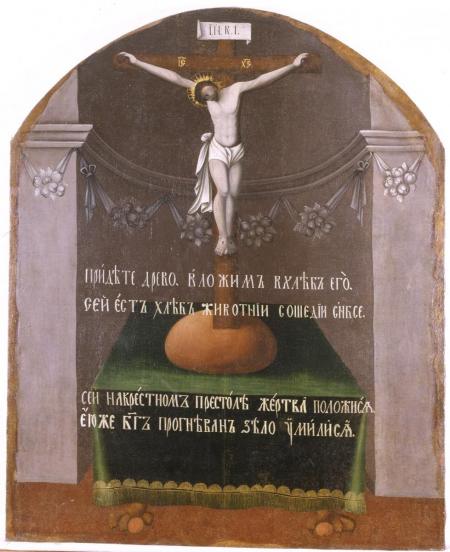
The icon of the Crucifixion on the canvas of the Trinity Gate Church is an original work of art of the Preserve collection. It was painted in Lavra painting school in the 20-30s of the 18th century. It is part of a series of paintings about the main Christian sacraments, placed on the reverse side of the iconostasis of this church. The introduction of the composition “Crucifixion” to the thematic cycle “Seven Sacraments” was traditional for the monumental ensembles of the Lavra School of the Baroque period. In the 18th-19th centuries, the iconographic images were placed not only on the front but also on the reverse side of the iconostasis in the Kyiv-Pechersk Lavra.
Created with the participation of educated theologians, a complex allegorical composition of the work was influenced by Baroque aesthetics and poetics. The introduction of symbolic objects, such as bread, holy table, altar apse and apples in the lion's paws, intensified the Eucharistic theme. The bread is a well-known Christian symbol of the Body of Christ, and therefore of the sacrament of the Eucharist; the lion, according to medieval tradition, is a symbol of the Resurrection, and the apple in the lion's paw is a hint at the saving mission of Christ, who atoned the original sin. The inscription in the center of the composition plays an important role in the disclosure of the theological content: “Come, tree, let us put into his bread, this is the bread of life came down from heaven”, which is a paraphrase of the Gospel text: “This is the bread which came down from heaven” (John 6:58). 6:58). The inscription testifies that the consuming of the Body of Christ is the guarantee of eternal life. The verse text at the bottom also reveals the theme of the Eucharistic Sacrifice: “The Sacrifice rests on the crucifixion, which moved the God in anger”. This is a typical example of the poetic work of the Baroque “scientist”, because the vast majority of Lavra monks of the 18th century, who developed theological programs for paintings of the Lavra School before their performance, were highly educated students of Kyiv-Mohyla Academy.
The icon was displayed at exhibitions of the Preserve. It was restored in 1980–1982 by the restorer of the highest category V. Podkopaeva.
Let’s #stayathome and discover the beauties of the Preserve’s collection together!
#museumfromhome, #museumcoffeebreak, #museumteabreak
/socialmedia/icons/levelten/glossy/32x32/youtube.png)
/socialmedia/icons/levelten/glossy/32x32/facebook.png)
/socialmedia/icons/levelten/glossy/32x32/twitter.png)