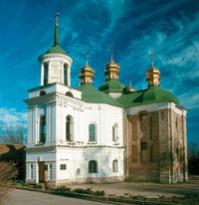
National Kyiv-Pechersk Historical and Cultural Preserve has joined the challenge #MuseumFromHome.
 Dear Friends!
Take a trip to our virtual museum during your coffee or tea break and make your #quarantinediscoveries!
Admire unique cultural assets of the Museum Fund of Ukraine!
The Philanthropy is considered a good Ukrainian tradition, but the scale of the charity work in the time of Ivan Mazepa's Hetmanate is striking. Modern researchers have called the art of his day Ukrainian Baroque, also often called Mazepynske or Mazepas.
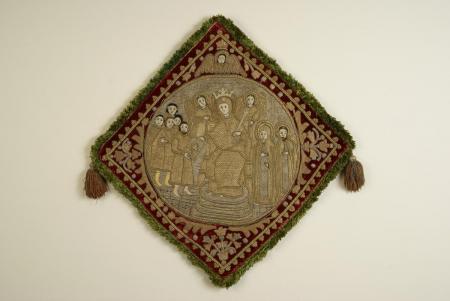
The epigonation, presented to your attention, is an example of Ukrainian church embroidery of the late 17th century (42,0 × 42,0 cm in size). It was embroidered by the nuns of the Kyiv-Ascension Convent, headed by Hegumenia Maria Magdalena, the mother of Ivan Mazepa. It was intended to the Father Superior of Krupytskyi Baturyn Monastery (apparently for St. Dymytriy (Tuptalo)). After the destruction of Baturyn by the troops of Peter I in November 1708, the epigonation got to the vestry of St. Sophia of Kyiv Cathedral.
The epigonation is part of the full liturgical vestment of a bishop, archimandrite, or a priest who was awarded. It is worn on the right side of the body upon the vestment. It is a diamond-shaped piece of fabric, suspended by one corner from a strap. It is considered to symbolize the sword of the Spirit, which is the Word of God, in which priests should be armed to combat unbelief and wickedness. It is the priests weapon to defend the faith by smiting all that is impure and vicious. This epigonation from the collection of the Preserve is made of crimson velvet, sewn with a leaf-gold. The Virgin Mary on the throne is in the center of the circle. She hands over the icon Mother and Child to those standing before her to the right. Sts. Anthony and Theodosius of Pechersk are standing to her left. The crown and scepter of Our Lady are decorated with fine pearls. An angel is embroidered in the upper corner. The other three corners are decorated with stylized bunches of flowers. The edges of the epigonation are trimmed with a fringe of green silk threads. Tassels of silk and silver threads are sewn at two corners. The epigonation has been part of the Preserve's collection since the 1920s. It was exhibited more than once. The results of the research of the relic were reported in scientific publications. It was restored by Inna Chernokapska, the art restorer, in 1999-2001.
Lets #stayathome and discover the beauties of the Preserves collection together!
#museumfromhome, #museumcoffeebreak, #museumteabreak
/socialmedia/icons/levelten/glossy/32x32/youtube.png)
/socialmedia/icons/levelten/glossy/32x32/facebook.png)
/socialmedia/icons/levelten/glossy/32x32/twitter.png)