Artistic Heritage of Kyiv-Pechersk Lavra
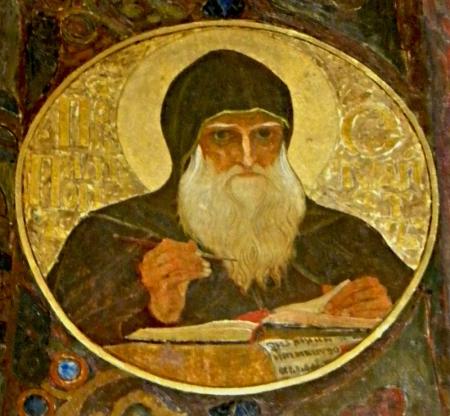 Saint Platon the Studite
Dear friends!
Today’s release of our “Artistic Heritage” column is dedicated to the image of St. Platon the Studite.
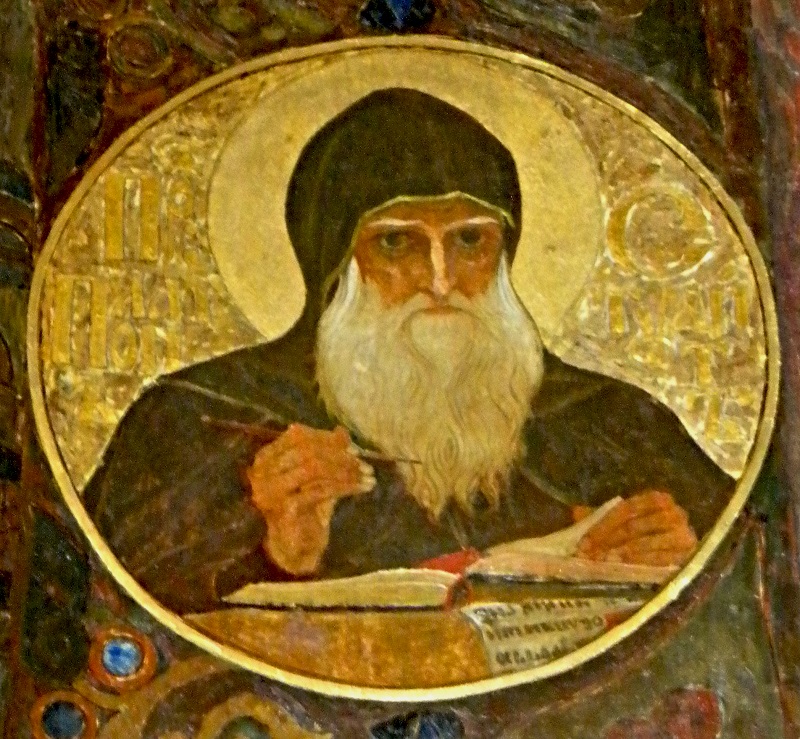
It is one of the wall paintings of the Church of Sts. Anthony and Theodosius of Pechersk in Lavra. Among the medallions with the images of saints painted by Ivan Izhakevych and placed on the arches of the Church, the image of St. Platon the Studite attracts special attention. Father confessor Platon was born in the 8th century. in Constantinople in the family that had a noble origin. After distributing his belongings among the poor, Platon left for the monastery built on Mount Olympus in Moesia. He lived and worked there for many years, rewriting books and collecting the writings of the Holy Fathers.
The painting of Ivan Izhakevych depicts St. Platon the Studite at work. The latter is holding the stylus in his hand. The image is very similar to that of Hegumen Nikon, Pechersk saint, painted by the artist on one of the walls of the Refectory two years earlier. Platon’s sight is directed slightly above the viewer’s head (copying St. Nikon’s gaze), and into the distance. Due to this technique, both characters painted by Izhakevych look as if they are deeply immersed in their thoughts. The page of the book, St. Platon the Studite was reading a minute ago, is laid with a finger. Just like it was done by St. Nikon. Thus, one can feel quite confident that the artist used his own ”know-how” practices while painting the image of St. Platon the Studite.
From under this book you can see a sheet of parchment with the word “oblichayesh” (“rebuke”) which is read quite clearly. It was typical for Izhakevych to write words or phrases on scrolls. Usually they belonged to one or another saint that he painted on the walls of the Refectory. If desired, the phrase can be seen, despite the great distance between the person standing below and the holy person whose image is painted above. This fact gives us the ground to suggest that the artist adhered to historical or documentary accuracy not only in attributes and clothing, but in text fragments as well.
Elder Platon’s eyebrows look like two white stripes. His gray white beard is stylized in the form of regular wavy curls. Platon’s clothes are simple and ascetic. His head is covered with a monk’s hooded cowl.
Caption to the illustration:
1. Ivan Izhakevych. St. Platon the Studite. Early 20th century. Wall painting of the Church of Sts. Anthony and Theodosius of Pechersk.
The text was prepared by Olena Pitateleva, the senior research worker
Research Division for the study of the artistic heritage of the National Kyiv-Pechersk Historical and Cultural Preserve
/socialmedia/icons/levelten/glossy/32x32/youtube.png)
/socialmedia/icons/levelten/glossy/32x32/facebook.png)
/socialmedia/icons/levelten/glossy/32x32/twitter.png)