National Kyiv-Pechersk Historical and Cultural Preserve has joined the challenge #MuseumFromHome
 Dear Friends!
While the monuments of the Preserve are temporarily closed for visiting, we invite you to spend these days in informative and educational way. Take a trip to our virtual museum during your coffee or tea break and make your #quarantinediscoveries! Keep exploring outstanding monuments of the World Cultural Heritage!
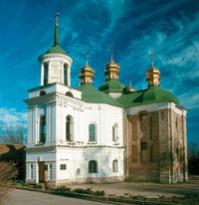
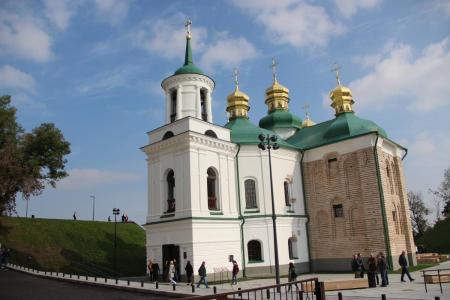
Сhurch of the Savior at Berestove (Church of the Transfiguration of Christ)
The construction of the Church is traditionally associated with the tenure of Prince Volodymyr Monomakh on the Kyivan throne (1113–1125), although some experts date it to the end of the 11th century. In the chronicle the Church is mentioned as the burial vault of the members of the Monomakh Princes family. According to the chronicle the daughter of Prince Volodymyr Monomakh Euphemia (1138), his son, the Prince of Kyiv Yuriy Dolgorukyi (1157), and grandson Glib Yurijovych (1171) were buried there. In former times an antechurch was attached to the Church from the west that has survived until nowadays; a baptistery was added from the north and a round tower with winding stairs leading to the choirs was added from the south. Inside the Church, the walls were covered with fresco painting. A big composition the Miraculous Catch of Fish of that period has been preserved till our times. It was discovered in 1970 under the painting of the 17th century. About 500 graffiti of different periods were found on the walls. After the Mongol invasion of 1240, the Church dilapidated. In the early 1640's, the Kyiv Metropolitan Petro Mohyla restored it, though not in its original volume. Three altars were added to the ancient antechurch, dedicated to the Transfiguration of Christ (Main Alter), to Grand Prince St. Volodymyr, Equal-to-the Apls. (Northern Alter) and Sts. Cosmas and Damian (Southern Alter). Greek masters executed the new wall painting of the Church. In 1751-1752, an antechurch was added to the western wall. Therefore, the Church was transformed into a typical Ukrainian five-part cruciform church. In 1813-1814, the architect Andriy Melenskyi completed the construction of the bell tower and thus the church acquired the architectural features of three different epochs from Kyivan Rus architecture to the late Classicism. By the end of the 19th century, the Church of Savior at Berestove was the parish church of the Pechersk town. However, in 1889 St. Olexandr Nevskyi Church was built in Lipki district and the Pechersk parish was transferred there. In 1897, the Church of the Savior passed to the community of members of Edinoverie (Old Believers). The members of the community kept the building in an unsatisfactory condition, repeatedly tried to make unauthorized changes to its paintings and even tried to remove the ancient crosses on the domes. Because of this, in 1908 the Church came under control of the Kyiv-Pechersk Lavra. During 1909-1914, the restoration work under the direction of the academician of architecture Petro Pokryshkin was carried out in the Church. The plaster was removed from the walls that survived from Mongolian times, having opened the Kyivan Rus masonry. The losses have been filled with new inserts from the interior and exterior of the Church. Fortification earthworks of the late 17th early 18th centuries, located close by the eastern wall of the Church, caused the soaking of the foundations and represented the danger to the Church. Under the guidance of Petro Pokryshkin, the part of the earthworks was removed and in 1914 the foundations of the lost volume of the monument were excavated. After the completion of the repair work, the Church, in fact, got the status of monument and divine service was no longer held there. In Soviet times, the Church became part of the Kyiv-Pechersk Preserve, and since 1932 it has been opened to visitors as a museum. In 1990, the Church of the Savior at Berestove was inscribed to the UNESCO World Heritage List as component of the architectural ensemble of the Kyiv-Pechersk Lavra.
#янакарантині, #музейзафіліжанкоюкави #stayathome, #museumfromhome, #museumcoffeebreak, #museumteabreak
/socialmedia/icons/levelten/glossy/32x32/youtube.png)
/socialmedia/icons/levelten/glossy/32x32/facebook.png)
/socialmedia/icons/levelten/glossy/32x32/twitter.png)