Artistic Heritage of Kyiv-Pechersk Lavra Saint Nikon Pechersky
 Dear friends!
We continue to acquaint you with Artistic Heritage of Kyiv-Pechersk Lavra.
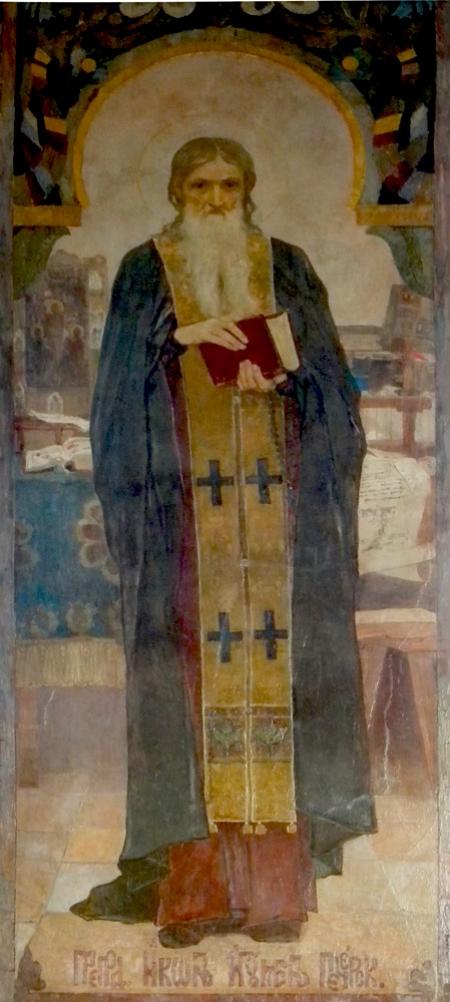
The paintings of Lavra’s Refectory and the adjoining Church of Sts. Anthony and Theodosius Pechersky are again in the focus of our attention. In particular, we will talk about the image of St. Nikon Pechersky.
You can find his portrait, created by Ivan Izhakevych, the painter, among numerous frescoes of Pechersk Saints in the Refectory.
St. Nikon was a scribe, Father Superior of the Monastery, companion of Anthony and Theodosius Pechersky, the predecessor of Nestor the Chronicler. Quite probable that it was he, who kept writing Pechersk Chronicle in 1050–1080.
According to Dmytro Likhachov, Nikon contributed to the appearance of a new genre that was unknown in Byzantine literature. He also thought that Nikon, being a historian, had the hedge over his contemporaries. Nikon commented on the records of his predecessors, checked other sources to verify the truth of certain statements. He also made logically connected pieces of information from different parts of the Chronicle, set out several versions, trying to prove one of them.
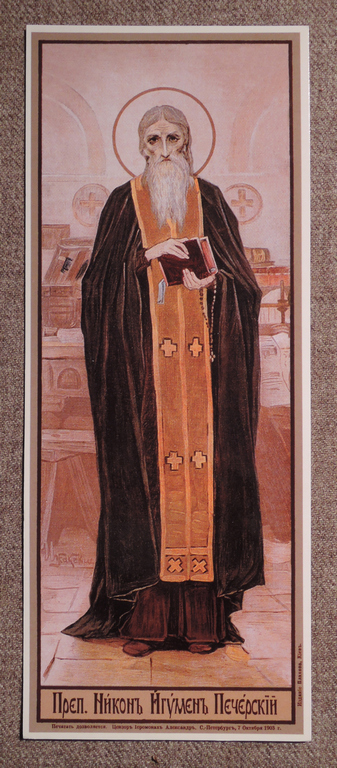
It is known that Father Superior Nikon also bound books and decorated Monastery with iconic scriptures and mosaics. Those three particular components of the monk’s activity during his stay in Kyiv-Pechersk Monastery were those that the painter Ivan Izhakevych reflected in his artistic composition. And he did it vividly, accessible, and convincingly.
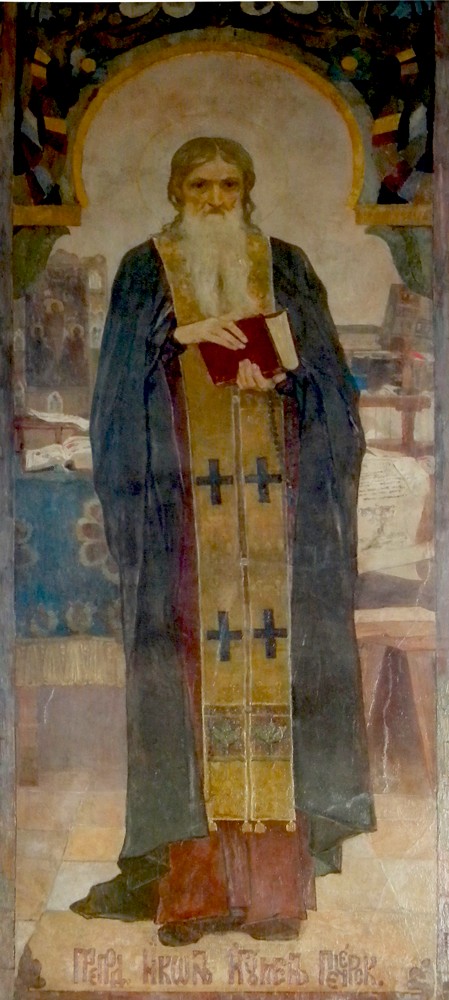
A page of the manuscript with a large braided initial lies on the table, to the left of St. Nikon’s figure. There is also a wooden device is seen here. Nikon used it for making book frames. The absence of folio backs shows quite clearly what that drying machine was used for. On the opposite side of the table you can see a kiot with an icon. Its frame is decorated with overlay plates made of metal or enamel (the viewer can guess what material those inserts were made of by the specific luster on the frame). Nikon holds the book with his hand. Necessary page that he found, is kept by his finger.
Father Superior’s face does not generate sympathy. His thinned lips that speak for the old age, are hidden by the mustache and almost invisible. His eyes are smart but look severe. His general glance is cold and even hard. Probably Ivan Izhakevych, who was familiar with Nikon’s biography, remembered that his hegumen’s status provoked disputes with the brethren. Monks considered him as an extremely stern person, though he was rather fair-minded man.
On one of the postcards, the series of which was prepared by Ivan Izhakevych for P. Plakhov’s Publishing House, St. Nikon’s image has a specific accent. It is exhaustion. Nikon Pechersky’s face has wrinkled and sunken cheeks. The psinter enlarged and darkened his eyes, forced yellow shadows on his lower eyelids, lengthened and sharpened his nose. All this gave an expression of excessive sadness to the Nikon’s image. It is quite clear that Ivan Izhakevych wanted to emphasize the feeling of pity on that graphic postcard. But to leave that psychological nuance on Lavra’s mural portrait of St. Nikon was absolutely impossible. That interpretation of hegumen’s image would have never be approved by Lavra’s Spiritual Council. It is known that that organ thoroughly and meticulously considered the image of each monk even at the sketcher’s stage.
Captions to the illustrations:
1. Ivan Izhakevych. St. Nikon Pechersky. Early 20th century. Paintings of the Refectory Chamber adjoining the Church of Sts Anthony and Theodosius of Pechersk.
2. Ivan Izhakevych. St. Nikon Pechersky. Postcard. P. Plakhov’s Publishing House. Early 20th century.
Prepared by Olena Pitateleva
Senior Research Associate
Research Division of Studying Artistic Heritage
/socialmedia/icons/levelten/glossy/32x32/youtube.png)
/socialmedia/icons/levelten/glossy/32x32/facebook.png)
/socialmedia/icons/levelten/glossy/32x32/twitter.png)