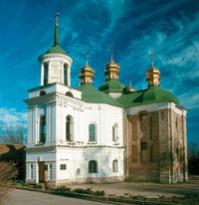
“Memories of Kyiv-Pechersk Lavra” photo project
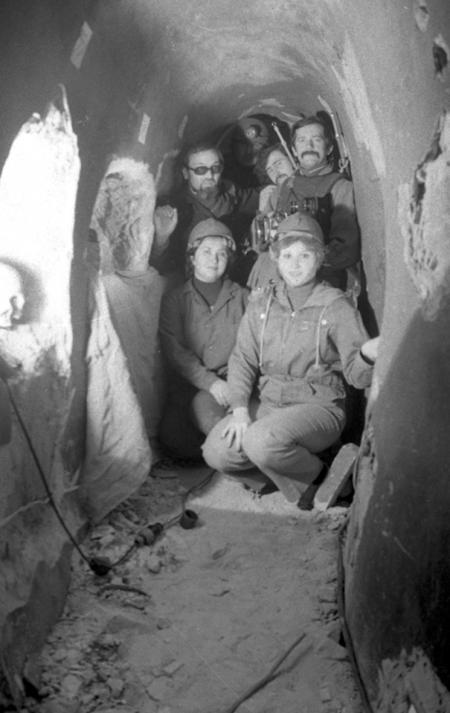 Archaeological research of the Near Caves of Kyiv-Pechersk Lavra
This week we begin a series of stories dedicated to the archaeological research of the Near Caves in Kyiv-Pechersk Lavra. The research lasted two years and significantly enriched our knowledge about the ancient history of
Kyiv-Pechersk monastery.
In November 1977, the Administration of the Kyiv-Pechersk State Historical and Cultural Preserve issued the order, according to which the Near Caves were closed for the repairing works. That was the second closure of the Caves (that fulfilled the function of the exposition object of the Preserve) in fourteen years. It is worth reminding that Near Caves were opened for the visitors on November 27, 1963. In 1971 they already underwent repair and restoration activities. This time the workers planned to replace the old electric lighting, in accordance with the fire safety requirements. To do this, they were going to lay pipes with electric cable for low-voltage lighting under the floor. No other long-term archeological research was planned to be done there and then. On November 9, the workers began preparations for the repairs. Tombs, icons, and other church items were taken out from the Caves to protect them from contamination or even damage. The works were held by the researchers of the Division of the History of Lavra Caves as well as assistant workers. On November 14, the first cast iron slabs that covered the floor areas of the underground corridors were removed. Under them the workers found the sand layer and below - clinked bricks hidden from view. Somewhere the workers found metal pins or nails knocked in the brick floor. It turned out that they marked the burial places under the floor. On November 22, the first of them was found. The next day, the researchers of the Division of the History of Lavra Caves discovered the first archaeological findings in the Refectory Church area. Among those findings there were coins of the 19th-20th centuries, fragments of metal, glass, ceramics, pieces of smalt and leather. To lay the electric cable, it was necessary to make small trenches, so on November 30, the workers began to remove the bricks that covered the floor. This led to the opening of new burials in oak tombs, logs and earth pits. By December 21, 1977, there were eight of them already. The Administration of the Preserve decided to report about those findings. Relevant information was sent to the researchers of the Institute of Archeology of the Academy of Sciences of the Ukrainian SSR. On December 22, archaeologist I. Movchan visited the caves. Together with M. Tkachenko, the photographer and the researcher of the Division of the History of Lavra Caves, they descended to the caves and fixed the latest findings with the camera. Since then, the archaeological research in the caves has been carried out in collaboration with the representatives of the Institute of Archeology. In addition to the findings under the floor, the Preserve researchers found ancient closed areas in the walls of the nearby cave labyrinth. On March 17, 1978, a speleoarchaeological expedition led by O. Avagyan started working in the caves. To make the cooperation legal, the special contract was signed between the Preserve and the speleoarchaeologists. The members of the “speleo” group began clearing the ancient cave branch corridors. They were also shooting and measuring them. At the same time, dendrochronologists joined the group of Preserve researchers. They began working with wood findings. By that time, the repairing works have taken second place. The priority task was then centered on the full-fledged archaeological research of the Near Caves.
In the next release of “Memories of Kyiv-Pechersk Lavra” photo project we will continue our story about the archaeological research of the Near Caves of Kyiv-Pechersk Lavra that lasted in the late 70s of the 20th century (1977-1979). Besides, we are going to acquaint you with the findings that were searched out by the researchers of the Institute of Archeology and scientific staff of the Preserve.
Captions to the illustrations:
1. Caves closed for the repairing works.
2. Opening of the burial place under the floor. Yu. Tolkachov, T. Mozharovska
3. A film crew visited the excavation site. In the foreground from left to right: T. Kusok, T. Mozharovska
4. A short break in the fresh air. From left to right: V. Pryshchenko, T. Kusok - standing; V. Nazarov, Yu. Tolkachov, B. Zholdak, V. Kolpakova, M. Tkachenko – sitting
5. Before the commencement of site works. T. Kusok, D. Safronyuk
6. Research of burial places. From left to right: G. Sapozhnikova, T. Mozharovska, M. Tkachenko
7. Clearing the locules. M. Tkachenko
8. Clearing the locules. From left to right: M. Tkachenko, T. Kusok
9. Study of “demonical cells”. M. Tkachenko
10. Photo to commemorate the joint work. From left to right: O. Avagyan, M. Tkachenko, Yu. Tolkachov, T. Mozharovska, I. Movchan (head of the expedition), D. Golovan, T. Kusok.
11. I. Movchan (standing on the right) gives instructions before work. From left to right: Yu. Tolkachov, T. Kusok, T. Mozharovska, D. Safronyuk
12. Discovery of “Mercury’s Cave Corridor”.
13. A group of speleologists in front of the discovered “Nestor’s Cave Corridor”. From left to right: H. Novikov, K. Khomenko, N. Galushchak, O. Avagyan
14. Working session in one of the crypts of “Nestor’s Cave Corridor”. O. Avagyan - in the center
15. Installation of timbering in the “Nestor’s Cave Corridor”. O. Avagyan - in the center