Artistic Heritage of Kyiv-Pechersk Lavra. Tin chalice with the images of Sts. Anthony and Theodosius of Pechersk
In memory of art restorer Anatolii Marchenko
Dear friends!
We are glad to introduce the next release of Kyiv-Pechersk Lavra “Artistic Heritage”.
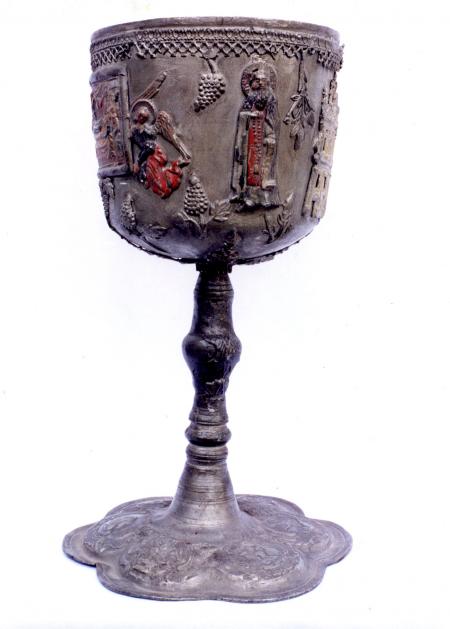
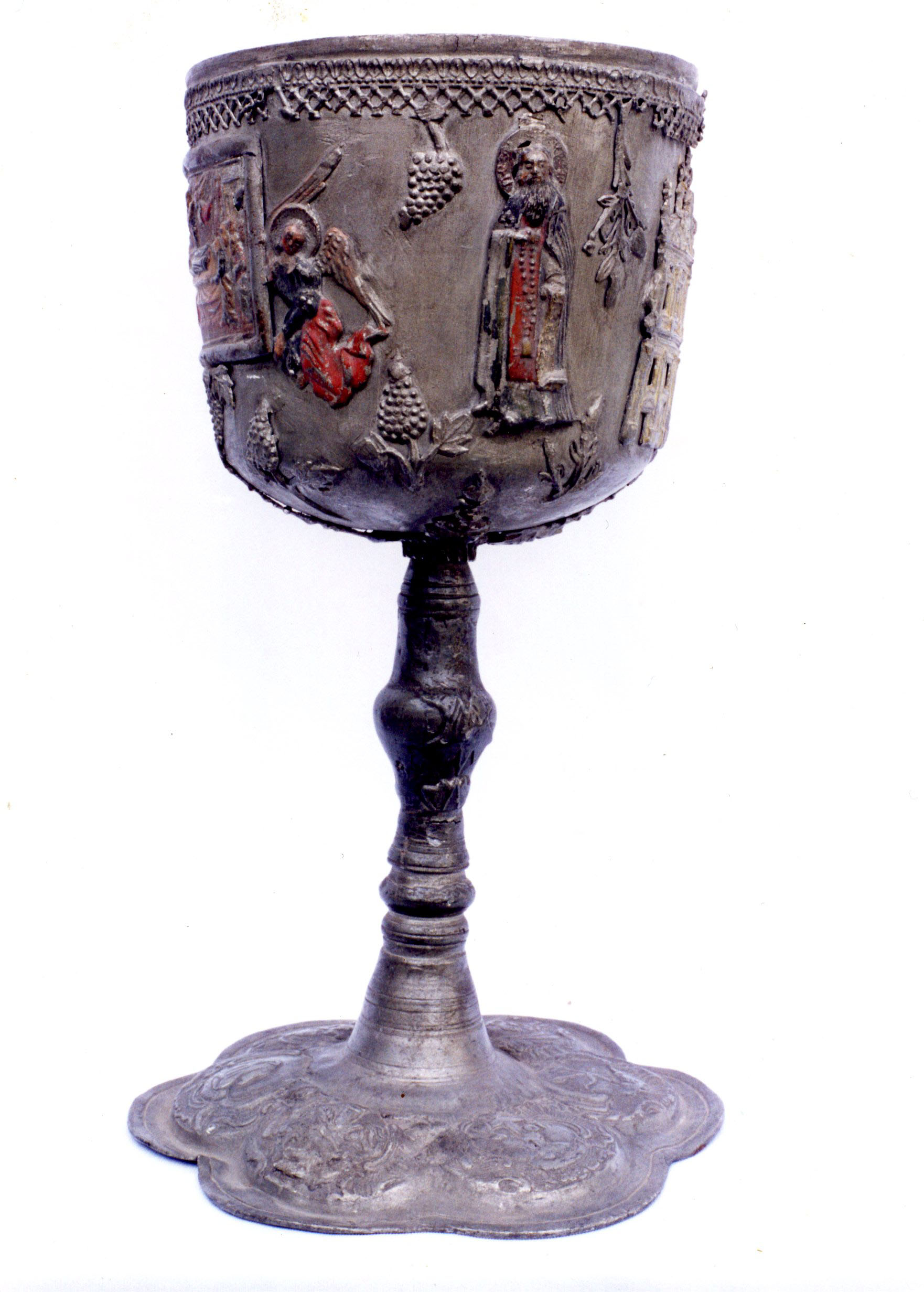
Today we are going to acquaint you with the item of sacred art of the late 18th century. It is a tin chalice with the images of St. Anthony and Theodosius of Pechersk from the Fund collection of the National Preserve “Kyiv-Pechersk Lavra” (KPL-M-9051).
It is known from ancient times that in most cases chalices were made of precious materials. At the same time, other substances, such as glass, copper and iron, were no less popular when it was time to create liturgical vessels. In 1769, the Holy Synod issued a decree that banned the usage of chalices made of wood, iron or copper, though liturgical vessels made of tin were allowed.
Tin has been known since ancient times. Its mentioning in the Bible (Chl. 31:23) is a clear proof of this fact. Silver-gray, plastic metal is not subject to corrosion and, therefore, ranks fourth after platinum, gold and silver. The disadvantage of this metal is its response to low temperatures. Then tin starts losing its silvery luster, becomes dull, gray and brittle. The products affected by the “tin plague” were remelted. As a result, not so many old tin vessels have survived.
Tin casting has been known in Ukraine since ancient times. Craftsmen that worked with tin in the 16th-18th centuries were called “convisarii” (from the Polish word “konwisarz” – tin-casting artisans). This type of metal was imported. Its largest exporter was England. Tin ware was common in those days. Secular and clergy used utensils made of tin. To make objects for religious purposes craftsmen used samples of precious metals. Some liturgical vessels were purchased by the Patriarchate Treasury Department to be sent to various monasteries.
Tin chalice from the Fund collection of the Preserve is one of the few monuments of tin casting of the late 18th century that have survived to our days. It was passed to the Preserve’s collection by the Church Archaeological Museum affiliated with the Kyiv Theological Academy. The chalice is quite large - its height is 33 cm, the diameter of the cylindrical bowl is 20 cm. Such massive chalices were used during crowded religious services.
Quite interesting is the decoration of the chalice. On different sides of the bowl one can see crosswise fixed relief overlay images of Sts. Anthony and Theodosius of Pechersk as well as the images of the Dormition Cathedral and “Dormition of the Blessed Virgin” icon held by two angels. The images are painted with multicolored paint. There are small bunches of grapes and twigs between them, above and below. Three-dimensional images of the tops of four churches go up the chalice’s stand, reaching the bowl in a crosswise manner. The exquisite decorative element of the bowl is its upper edging. The pallet of the chalice is in contrast to the common pottery of the 18th century. It is not tiered, almost flat and divided into six rounded petals with three-dimensional images of Torture Tools on each of them. The images are placed into figured cartouches.
The chalice was restored in 2003 by the art restorer Anatolii Marchenko. When the dirt was cleaned, there appeared inscription, scrabbled on the stand:
“1790 ГОДА_Ц:П:К»”, applied with a sharp tool. Anna and Anatolii Marchenko, the researchers that studied the sacral vessel in detail, tried to decipher those three letters and published their results in one of their articles.
Caption to the illustration:
Chalice. Late 18th century (KPL-M-905)
Prepared by Olena Serhii
Senior Research Associate
Research Division of Studying Artistic Heritage
/socialmedia/icons/levelten/glossy/32x32/youtube.png)
/socialmedia/icons/levelten/glossy/32x32/facebook.png)
/socialmedia/icons/levelten/glossy/32x32/twitter.png)