
The “Nativity of the Virgin” aer that was created in 1682 and now is part of the Fund collection of the National Preserve “Kyiv-Pechersk Lavra”
 Dear friends!
We continue to acquaint you with the Artistic Heritage of Kyiv-Pechersk Lavra.
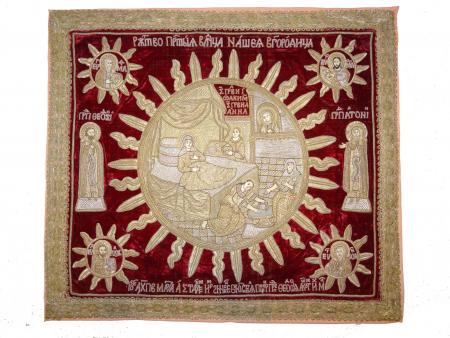
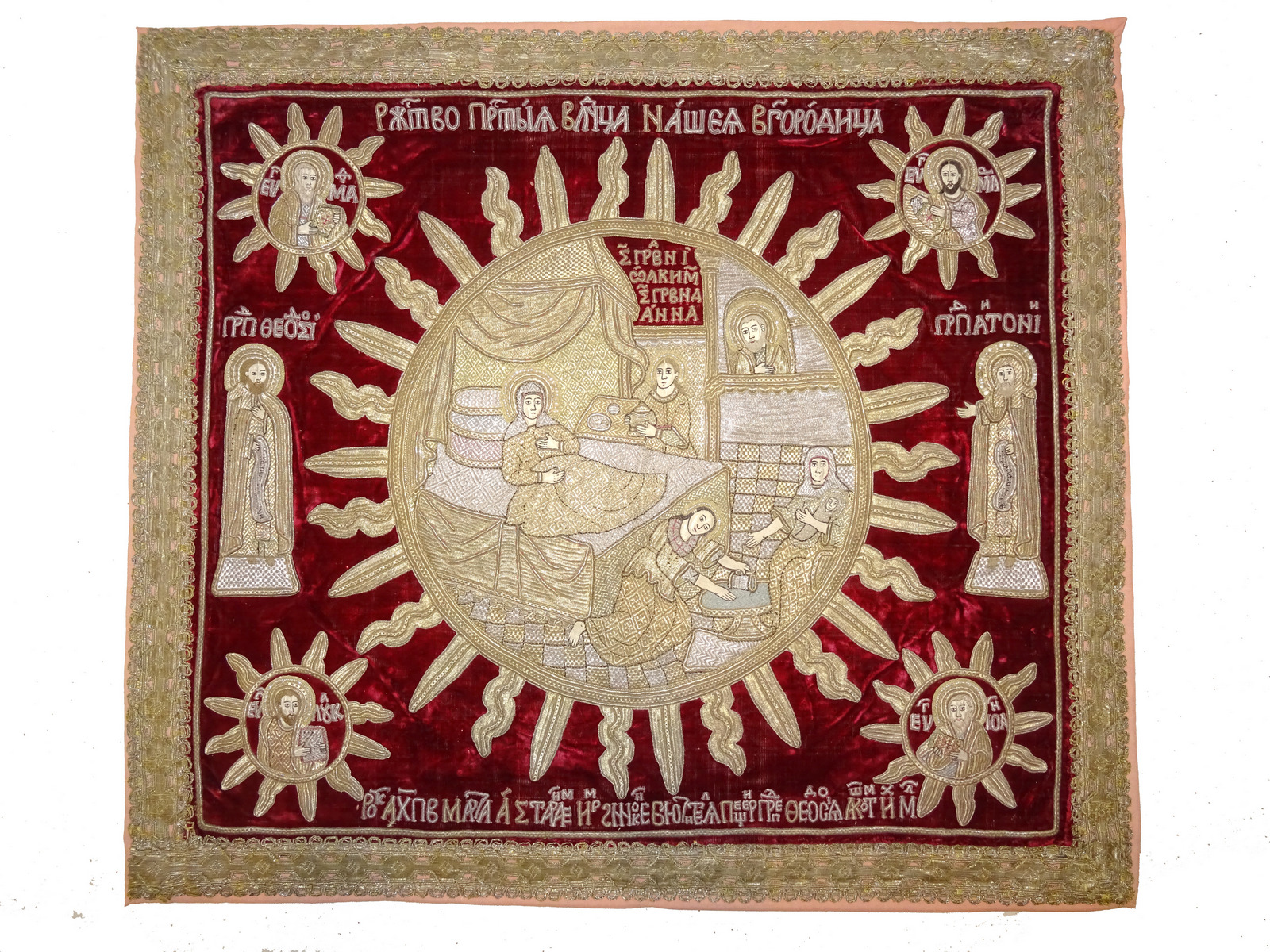
Today we will talk about the “Nativity of the Virgin” aer that was created in 1682 and now is part of the Fund collection of the National Preserve “Kyiv-Pechersk Lavra” (KPL-T-417. 76.0 × 68.0 cm).
The aer, which is a rectangular cover used to simultaneously overlay the chalice and the discus during the liturgy, is made of crimson Italian velvet and decorated with embroidery. The compositional scheme of this artistic work is typical for the Ukrainian aers made in the 17th - early 18th centuries. It consists of five radiant circles where the central circle has a plot composition and four angular circles are decorated with busts of evangelists. The central circle is flanked by the standing images of St. Anthony and Theodosius, the founders of Pechersk Monastery.
The scene of the birth of the Virgin Mary, located in the central part of the aer, is stylistically close to the engravings that we can find in Kyiv-Pechersk Lavra editions of the 17th century. This may indicate that Lavra’s artists participated in the development of the trace-drawing lines for the future embroidery. The composition develops in the in-plane format and gradually moves upward in several directions. In the foreground one can see two midwives that prepare a baptismal font for the baby. On the left, there is the image of the Righteous Anna lying on a massive bed, decorated with the baldachin. A servant maid is standing by the small table and is busy with something. The Righteous Joachim is looking from the window, which is above the entrance to the house. Attention to the foreshortening method, the use of “perspective” approach and modernized cut of clothes of the aer characters show the tendency of Lavra’s artists of the 2nd half of the 17th century to imitate the samples of Baroque European art. Technological features of the embroidery bring the aer closer to the works of Kyiv-Voznesensky convent - a prominent center of gold embroidery, which was situated across Pechersk Lavra and was under the patronage of its archimandrites.
According to the inscription carved in the lower part of the aer, the artwork was made in 1682 at the request of the hieromonk Innocent († 1693) - a Cathedral elder and clergyman of Kyiv-Pechersk Lavra brethren community, the overseer of the Far Caves. Apparently, the aer was intended for the Church of the Nativity of the Virgin, which was part of the complex of churches in these caves. The aer was donated to the Church of the Nativity of the Virgin together with two smaller velvet covers that have not survived. According to the description of the Far Caves church utensils of the 1769, the cross-shaped cover (that had the form of the Greek cross and was used to cover the chalice) had the embroidered image of the Infant Christ on the discus, which was located in the middle of the artwork. The figures of archangels were on the sides. The squared-form cover (used to overlay the discus) had the image of the Savior with the instruments of the Passion.
Prepared by Alina Varivoda, Ph.D.
Leading research associate
Study of Artistic Heritage Research Division
National Preserve “Kyiv-Pechersk Lavra”
#ArtisticHeritage
#МистецькаСпадщина
/socialmedia/icons/levelten/glossy/32x32/youtube.png)
/socialmedia/icons/levelten/glossy/32x32/facebook.png)
/socialmedia/icons/levelten/glossy/32x32/twitter.png)