Artistic Heritage of Kyiv-Pechersk Lavra
 Artistic Heritage of Kyiv-Pechersk Lavra
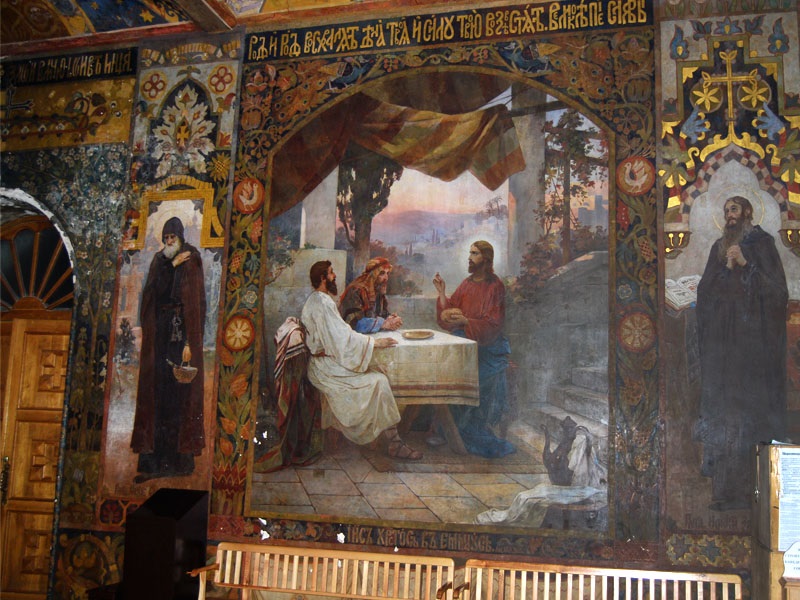
Miracle of Emmaus (in commemoration of the 970th anniversary of the first Chronicle about Kyiv-Pechersk Lavra)
Dear friends!
We are glad to introduce the next release of Kyiv-Pechersk Lavra “Artistic Heritage” to you. It will be about the wall painting in the Refectory, which adjoins the Church of Sts. Anthony and Theodosius of Pechersk.
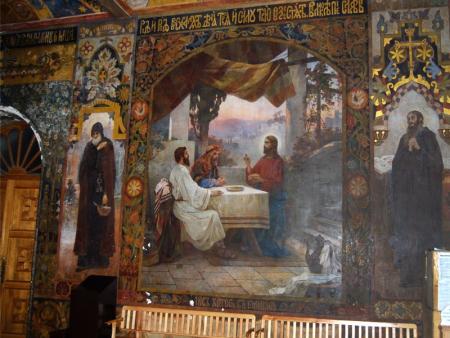
The artwork we are going to talk about is called “Miracle of Emmaus”. It is a wall composition, created by Heorhii Ivanovych Popov in 1903. Artistic skills of Lavra’s painter manifested themselves in this work very vividly.
The Bible story about “Miracle in Emmaus” was rarely used in the Orthodox art. However, in the Western European art, this plot was quite popular. It was associated with such painters as Carpaccio, Dürer, Tytsian, Tyntoretto, Velazquez, Rembrandt, Caravaggio, Furich, Levritt, Dore, Denis, Nolde and others.
The artwork is created in a clear and balanced manner. Heorhii Popov uses the technique that will later be repeated by him in the “Last Supper” altar composition: one of the disciples involuntarily moves forward when he recognizes the risen Christ, the other, on the contrary, recedes in shock. It is here, in this picture, where Popov for the first time uses the motif (of a jug and a washbasin with a towel) that has later become his favorite one.
Various spectator associations arise when one starts looking at the curtain, the function of which in Cleopas’ house is to shade the dining table and protect the people sitting behind it from the scorching sun. The striped fabric of the curtain has the same pattern as the mantle of one of the apostles, thrown over the back of a chair. Thus, the curtain seems to indicate the owner of the guest house. It is also probable that in depicting the curtain hanging on the ropes, the artist appeals to the velum, the fabric that sometimes unites the roofs of houses in the Byzantine and Kyivan Rus icons. A certain semantic association of “Emmaus” draping can be evoked by the velum fixed over the Edicule under the arch of the Jerusalem Temple. Such kind of curtain is depicted in the painting “Chapel in the Church of the Resurrection of Christ in Jerusalem” drawn by M. Chernetsov in the mid-19th century. Finally, the fabric, which is gathered in folds and hangs picturesquely over the heads of the seated, persistently evokes associations with the drapery presented in the sketch “Neapolitan Night” created by Mykhailo Vrubel.
Caption to the illustration
1. Heorhii Popov. “Miracle of Emmaus”. Painting in the Refectory Chamber adjoining the Church of Sts. Anthony and Theodosius of Pechersk. 1903
Prepared by Olena Pitateleva
Senior Research Associate
Research Division of Studying Artistic Heritage